
The Editing Engine
A developmental editor that never gets tired — built by TSI, and used on a finished book.
Copy-editing tools check spelling and grammar. They do not tell you that a phrase you love turns up four times in eleven pages, that chapter six has no shape, or that a passage no longer sounds like you wrote it. Those are the problems that make a manuscript feel wrong without a reader being able to say why — and they are the ones a human editor finds slowly and expensively.
We built an engine that finds them, and we used it on a real book before we described it here.
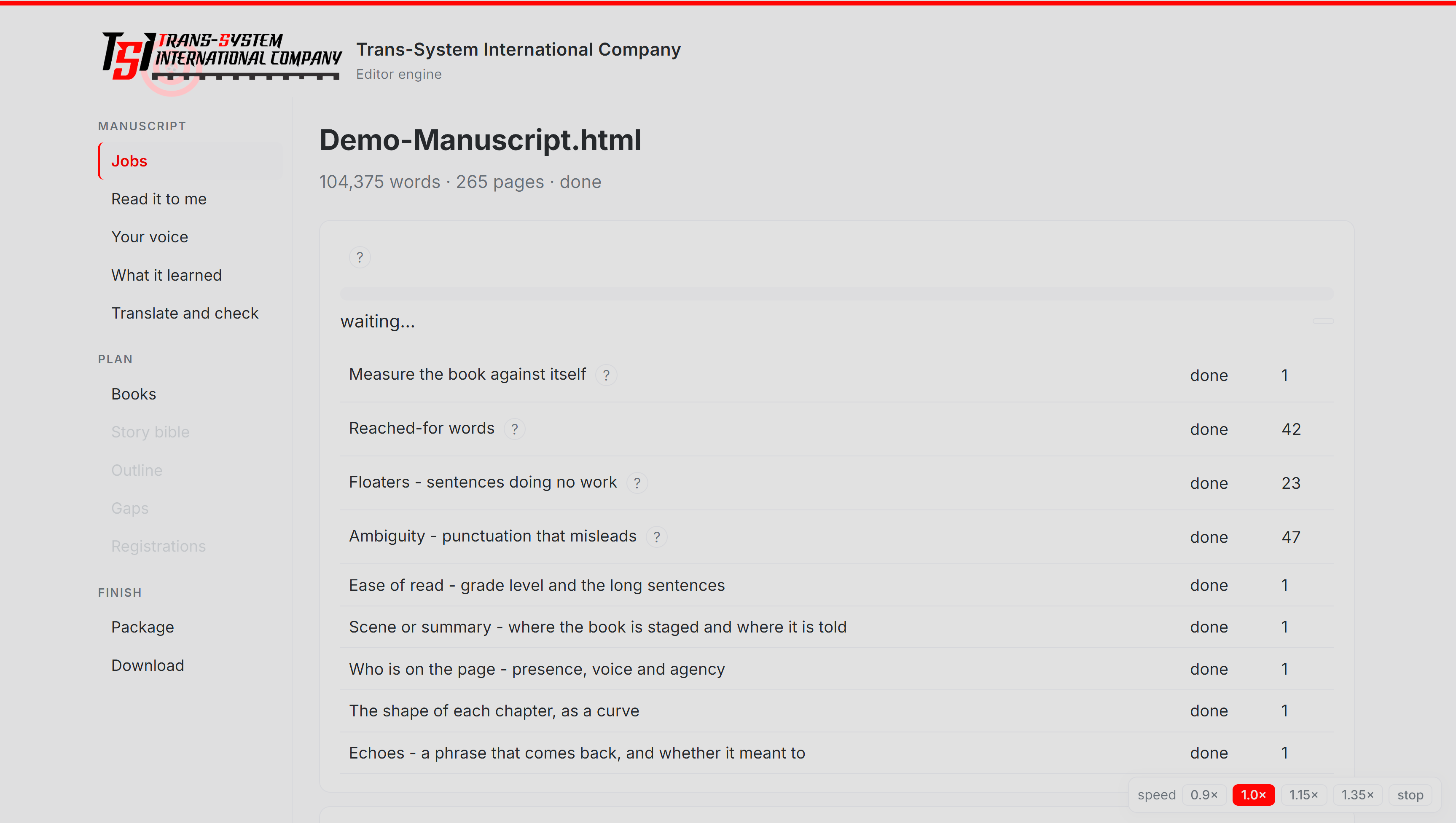
What it measures
- Reached-for words — the phrases a writer leans on without noticing.
- Floaters — sentences doing no work.
- Ambiguity — punctuation that makes a line say something it did not mean.
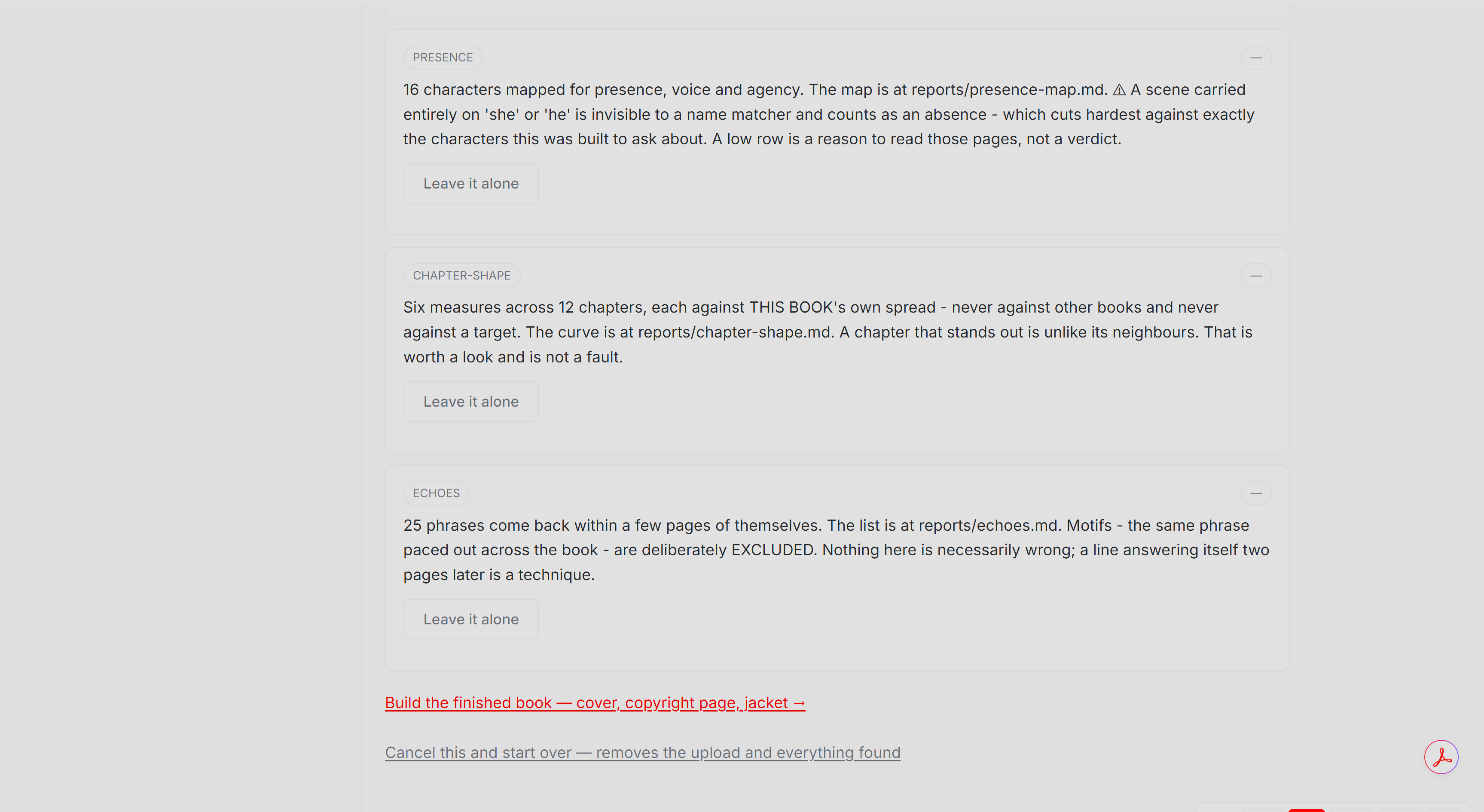
- Echoes — a phrase that comes back too close to itself, ranked by distance and rarity rather than raw count, so a deliberate motif is not flagged as a mistake.
- Chapter shape — six measures per chapter, each judged against this book's own spread and never against a target.
- Scene or summary — where the book is staged and where it is told.
- Presence — who is actually on the page, with what voice and what agency.
- Voice — whether a passage reads as the author's own writing.
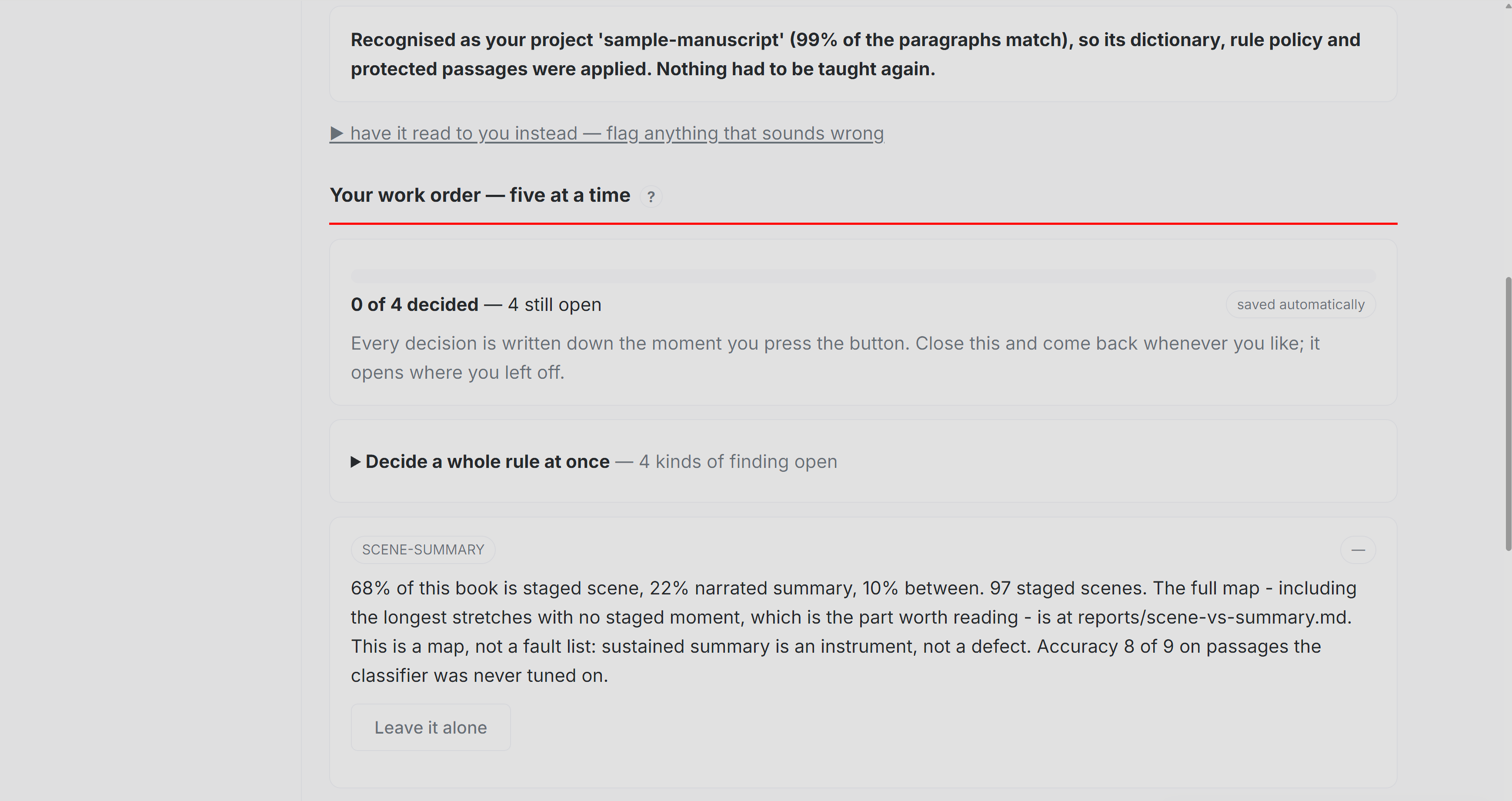
It reports. You decide.
Every finding can be acted on or left alone, and the decision is written down the moment it is made. Nothing is changed on the author's behalf. A measurement that stands out is a reason to go and read those pages — not a verdict, and not an instruction.
That distinction is deliberate. A tool that rewrites for you produces prose that sounds like the tool. This one is built to leave the writing alone.
Who it is for
- Authors and self-publishers — a structural read of a full manuscript before it reaches an editor, or a printer.
- Businesses with many writers — one measurable voice across documentation, proposals and marketing.
- Anyone defending their own work — authorship is measurable, and a writer accused of not having written their own pages should be able to show otherwise.
Built the way we build everything
The engine runs on our own infrastructure, its findings are reproducible, and it was tested the hard way — on a 100,000-word manuscript, by its author, through to a printed book. It is not a demonstration.